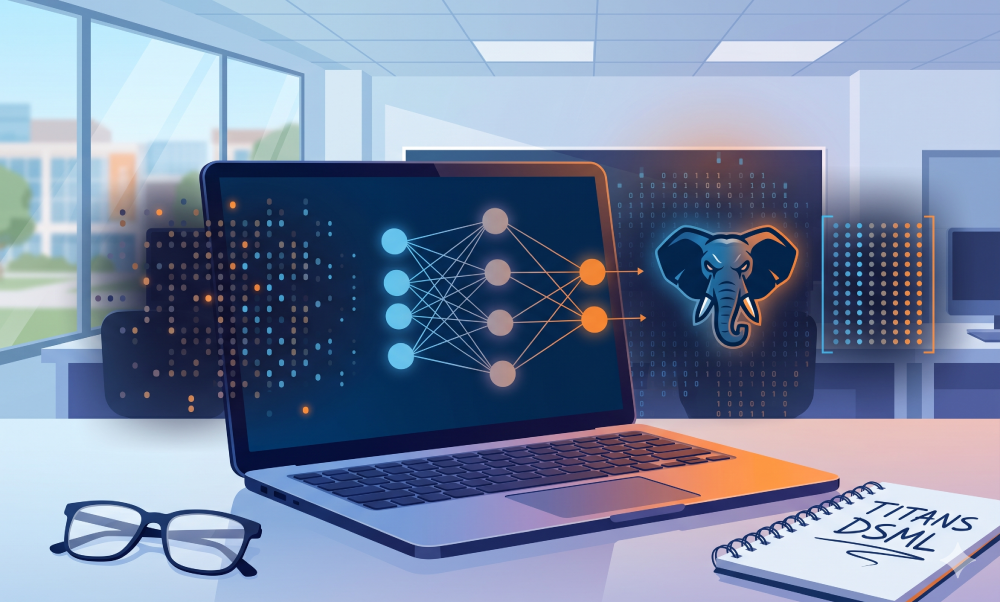
From Zero to Titan: Building Your First Neural Network on Campus
Introduction: The Blueprint for a Titan
Welcome to Cal State Fullerton, where a new type of Titan is emerging—one powered not just by strength, but by high-dimensional data and artificial intelligence.
The journey into Data Science and Machine Learning (DSML) can be intimidating. If you’ve ever opened a deep learning textbook or scrolled through arXiv, you’ve probably seen dense linear algebra and calculus notation that made you want to close the tab immediately.
The first lesson of the DSML Club? You don’t need a PhD to start building.
This is your guide to building your first simple neural network, right here on the CSUF campus. We are moving beyond theory and focusing on implementation. This isn’t just a tutorial; it’s a blueprint to becoming a Titan in the field of AI.
What is a Neural Network, Anyway?
At its core, a neural network is just a function that takes some input (like an image) and maps it to an output (like a label of what’s in the image). It’s inspired by the biological neurons in your brain, but fundamentally, it’s about finding complex patterns in data.
For our first project, we won’t try to build an autonomous vehicle. We are going to build the “Hello World” of Machine Learning: classifying handwritten digits.
Our goal is to take a 28×28 pixel image of a handwritten number (0-9) and train a model to tell us, with high accuracy, what that number is. This dataset is famous in the AI world and is known as the MNIST dataset.
Your Technical Toolkit
To build this, we’ll use the industry-standard “stacked toolkit.” If you don’t have this set up yet, don’t worry—one of our upcoming club workshops is dedicated entirely to Python environment configuration!
- Python: The programming language of choice for 99% of modern AI research.
- PyTorch (or TensorFlow): These are known as deep learning frameworks. They are powerful libraries that do the heavy lifting for mathematical operations, allowing you to focus on the structure of your network. We’ll be using PyTorch because it’s widely used in research.
- Jupyter Notebook: Think of this as a playground for data science. It lets you write code in “cells,” see the output immediately, and embed text and visualizations. It’s the standard for prototyping AI models.
Step-by-Step Implementation
Here is the high-level roadmap we’ll follow:
- Loading and Visualizing the Data: We’ll use PyTorch to download the MNIST dataset and use a library called
matplotlibto display the digits, seeing the 28×28 grayscale matrices. - Building the Network Architecture: We’ll define a simple “Multi-Layer Perceptron.” This is a basic network structure with a few layers of artificial neurons. We’ll start with an input layer, one hidden layer to find features, and an output layer with 10 nodes (one for each possible digit).
- Defining the Loss and Optimizer: We need two more key components. The “Loss Function” tells us how well or poorly our network is performing (e.g., how wrong its guesses are). The “Optimizer” is the algorithm that tells the network how to adjust its internal weights to minimize that loss and improve its accuracy.
- Training the Model: This is the magic part! We’ll loop through our data multiple times, a process known as training. The network will see the data, calculate its loss, and use the optimizer to update itself. We’ll see the “Accuracy” metric climb from near-zero to over 95%!
- Testing and Evaluation: Finally, we’ll take a separate set of data the model has never seen before and test it. A truly successful model generalizes well to new data.
Conclusion: Joining the Ranks
By the end of this project, you will have built, trained, and evaluated your own deep learning model from scratch. This isn’t just a theoretical exercise—it’s the first step towards specialization in any AI field, whether it’s computer vision, natural language processing, or even advanced research like mechanistic interpretability.
The best part? You don’t have to do it alone.
This guide is just the beginning. The core mission of the Titans DSML Club is to provide a collaborative space for CSUF students to take these first steps together. We hold weekly workshops where we go through this exact code, troubleshoot your errors, and work on real-world projects that look great on a portfolio.
Your First Challenge as a Titan: Come to our next meeting. It doesn’t matter if you’re a Computer Science Major, a Software Engineering Master’s student, or just a curious undergrad. We are all here to learn.
The future of intelligence is being built on campus. Let’s build it together.